
Home monitoring
Follow patients after discharge, with recordings a doctor can review later.
ECG and SpO₂ patch · working prototype
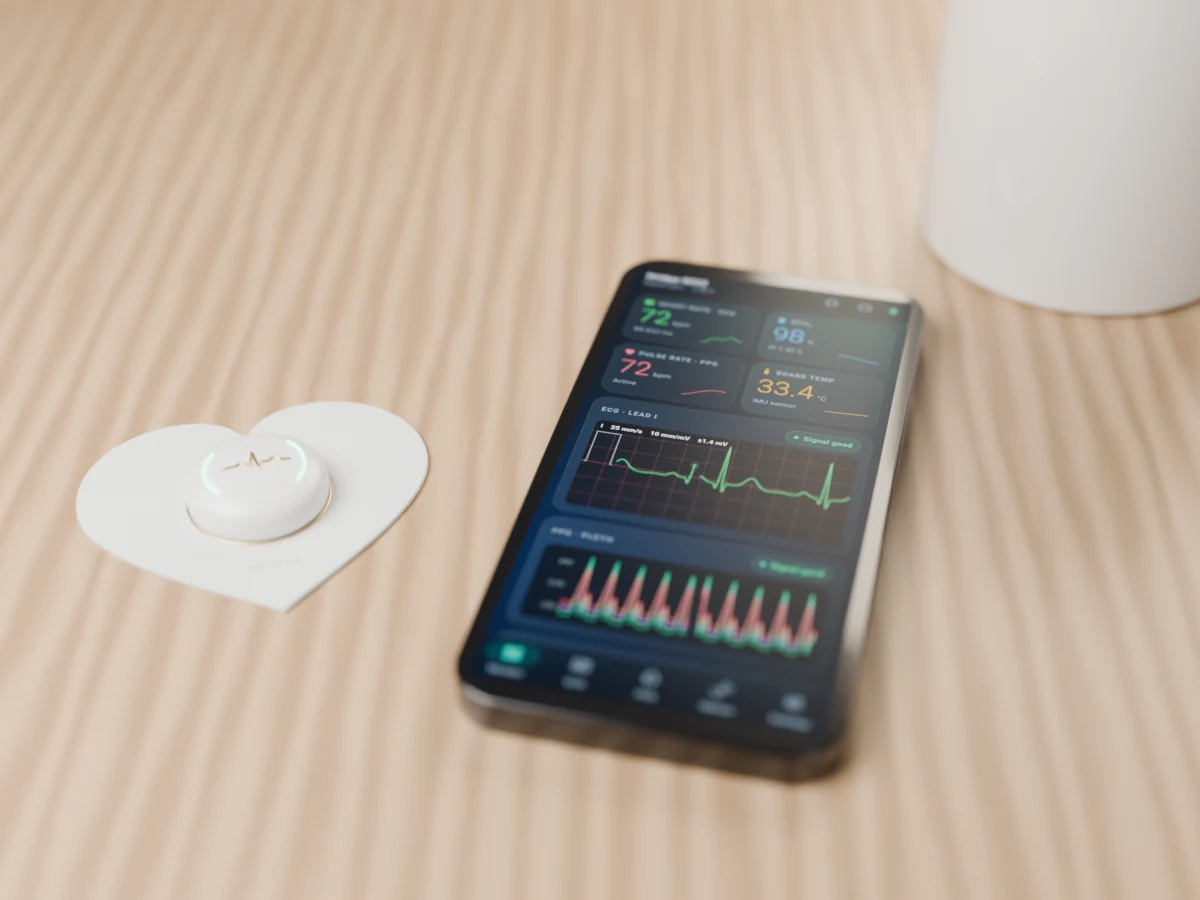
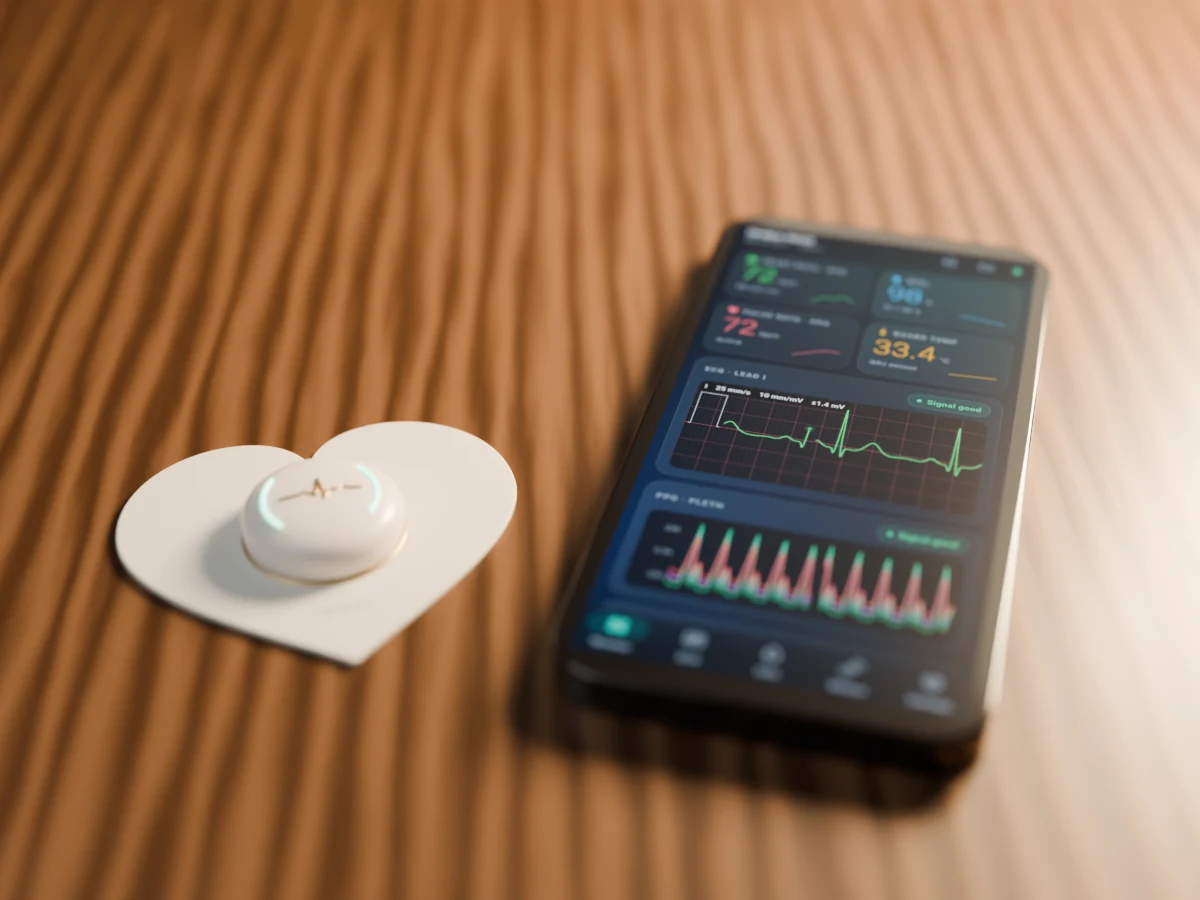
Hridya records ECG, pulse, SpO₂ and motion, and streams them to its own Android app. The prototype runs on the bench today. We are looking for companies that want to develop it with us into a medical wearable under their own brand.
For product teams
Getting a clean signal from the skin to the phone is the slowest part of building a new wearable. Hridya is past that step. Develop it with us and start from working hardware, firmware and an app.
Typically 2–4 weeks. Your users, markets, brand and sensors, turned into a written plan with costs, risks and a timeline.
A custom wearable board, enclosure, electrodes and adhesive, longer battery life, your branding and an iPhone app if you need one.
Bench tests against a reference ECG recorder, then small batches for a study with your clinical partner.
Design records toward IEC 60601-1, IEC 62304 and ISO 14971, ready for your regulatory partner and manufacturer.
Sensors, firmware, Bluetooth link, app and ECG reports already built and working together.
Enclosure, app and reports under your name. Commercial terms agreed in writing.
A mutual NDA before you share your plans. The engineers who built Hridya develop your version.
Related: develop an ECG patch under your brand · remote patient monitoring devices · ECG patch development in India
Hridya is a research prototype and is not certified. Timelines and costs depend on your requirements and are agreed in writing before work starts.
The prototype
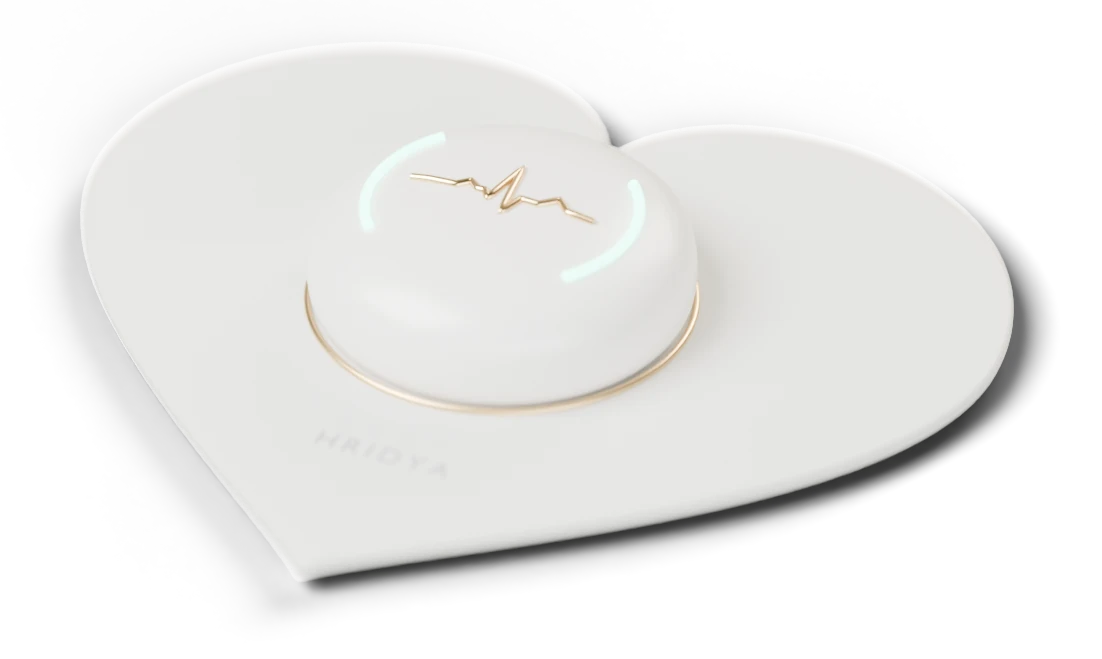
Hridya means “of the heart”. We built it as a complete working system: sensors, firmware, signal processing and app. It is the starting point for your product, and proof of what our team can build.
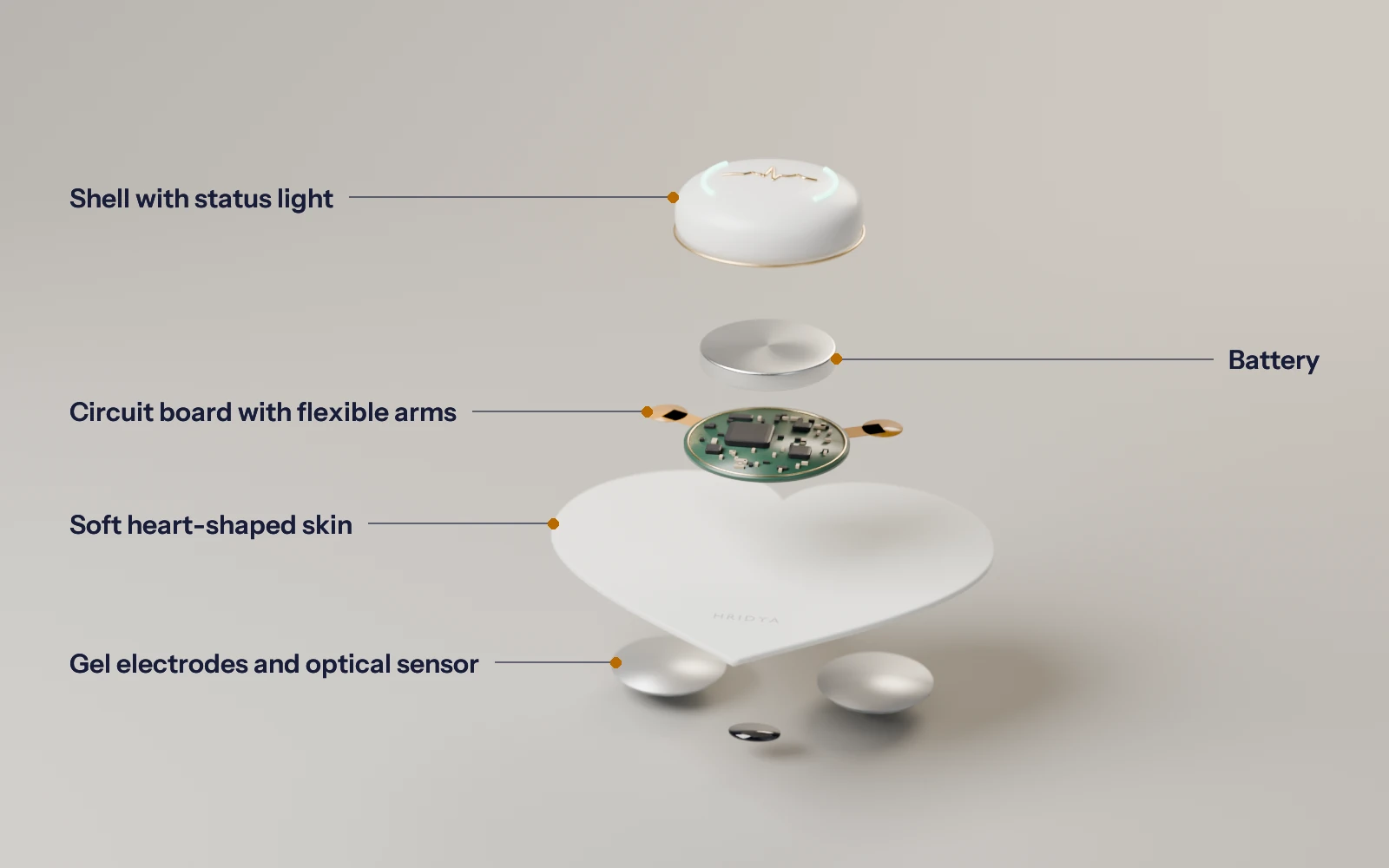
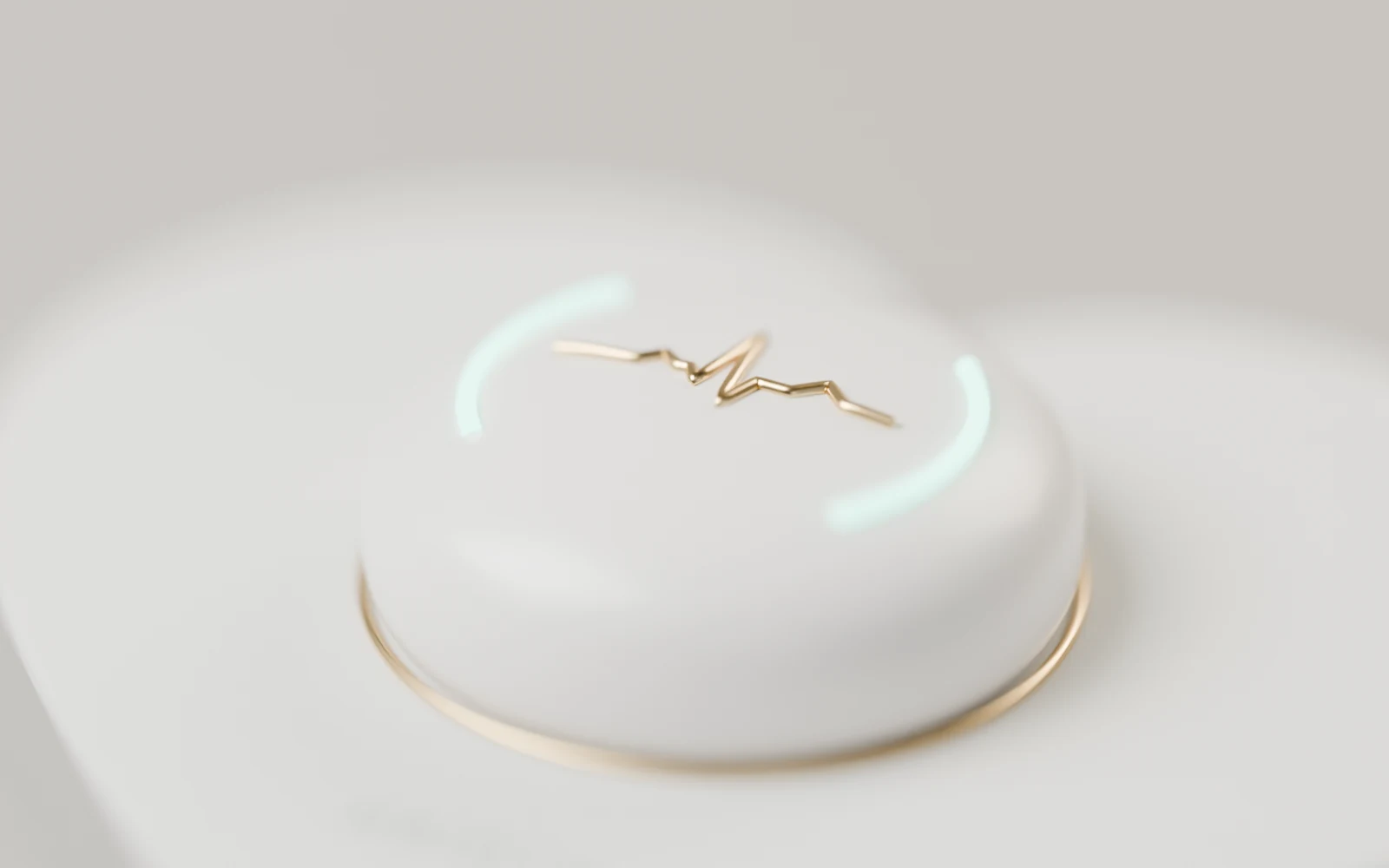
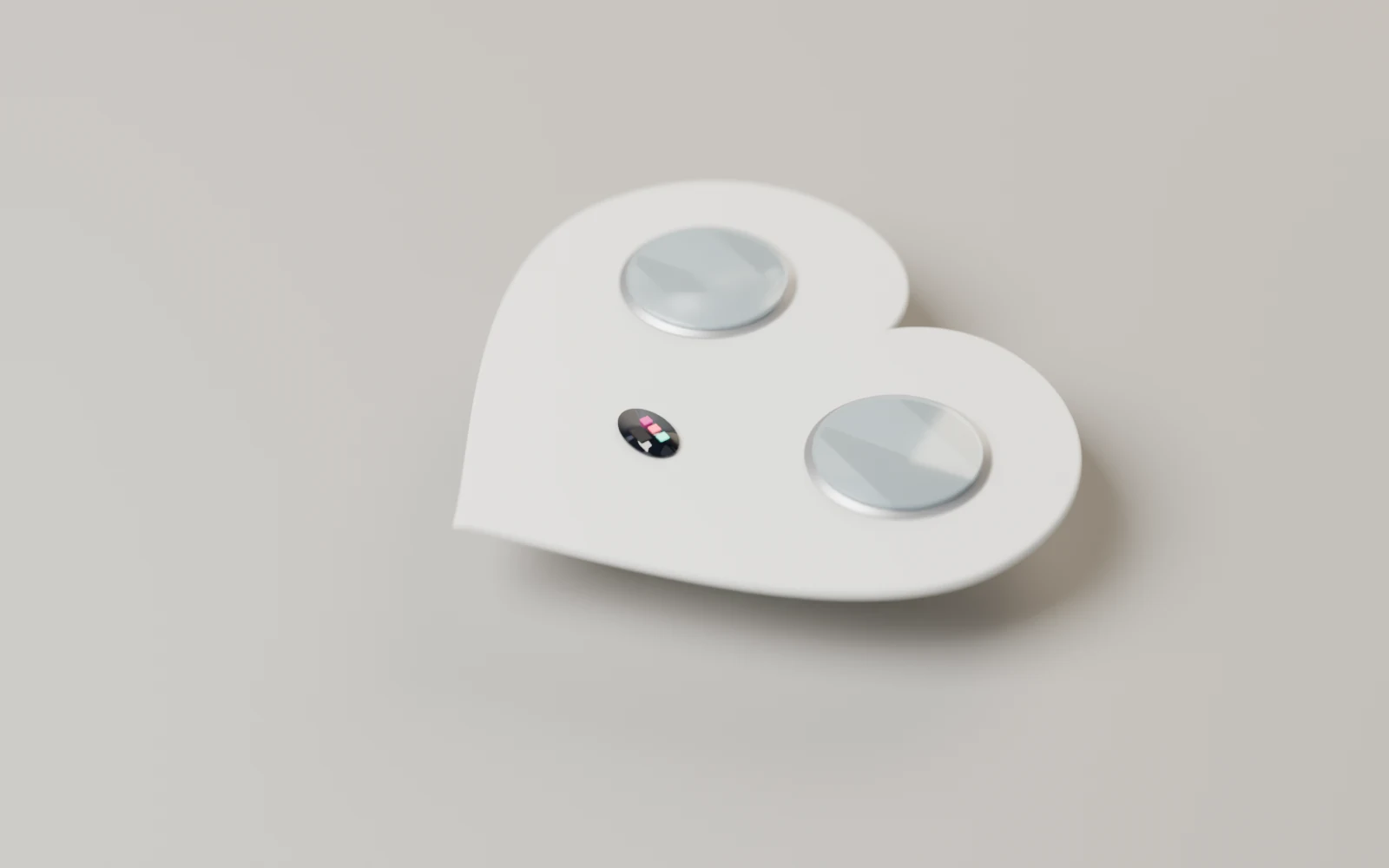
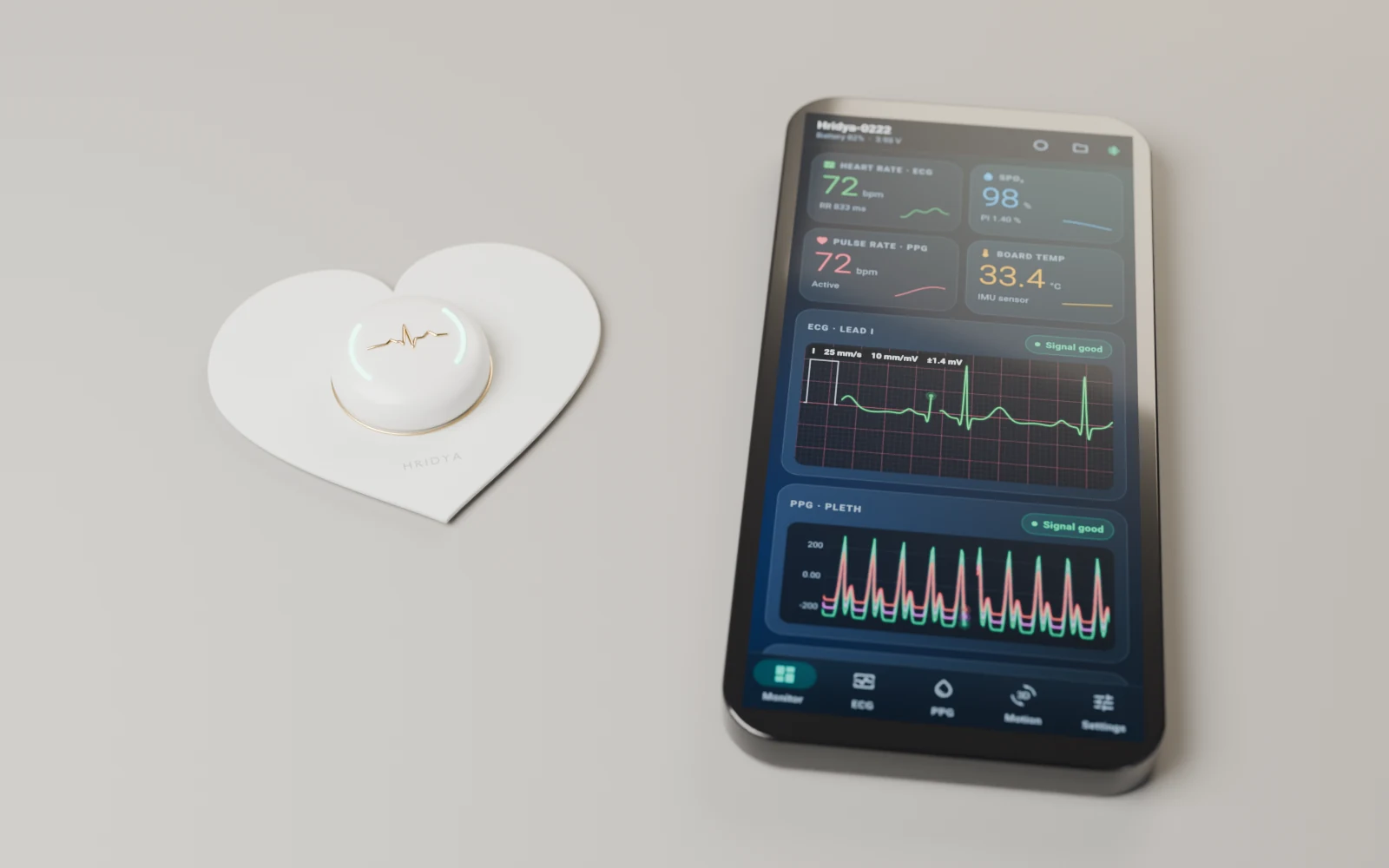
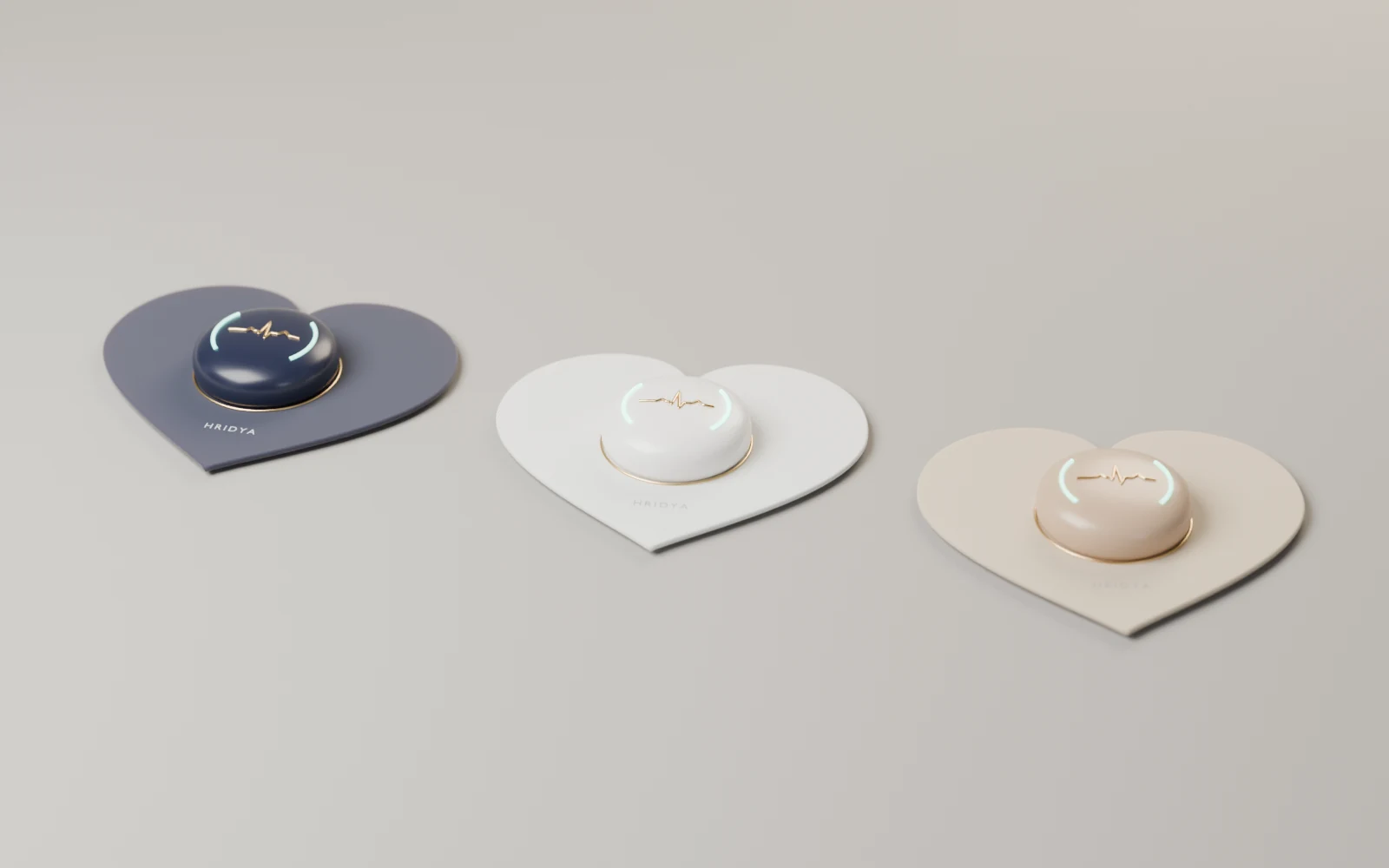
Enclosure concept shown as photoreal renders, built around our working V0.2 prototype.
The same model we use for the renders, at true size. Drag to rotate and pinch to zoom. On a supported Android phone you can place it in your room with the camera and see how small it really is.
About 0.7 MB, loaded only when you press the button.
The heart sits on the chest with an electrode under each lobe and the optical sensor under the pod. Nothing to clip on and no wires.
Progress
The first question every partner asks is what actually works. Here is the honest status, and what we develop next together.
Markets
The same core can become a product for remote patient monitoring, cardiac care or research. These are the settings partners ask us about most.
Follow patients after discharge, with recordings a doctor can review later.
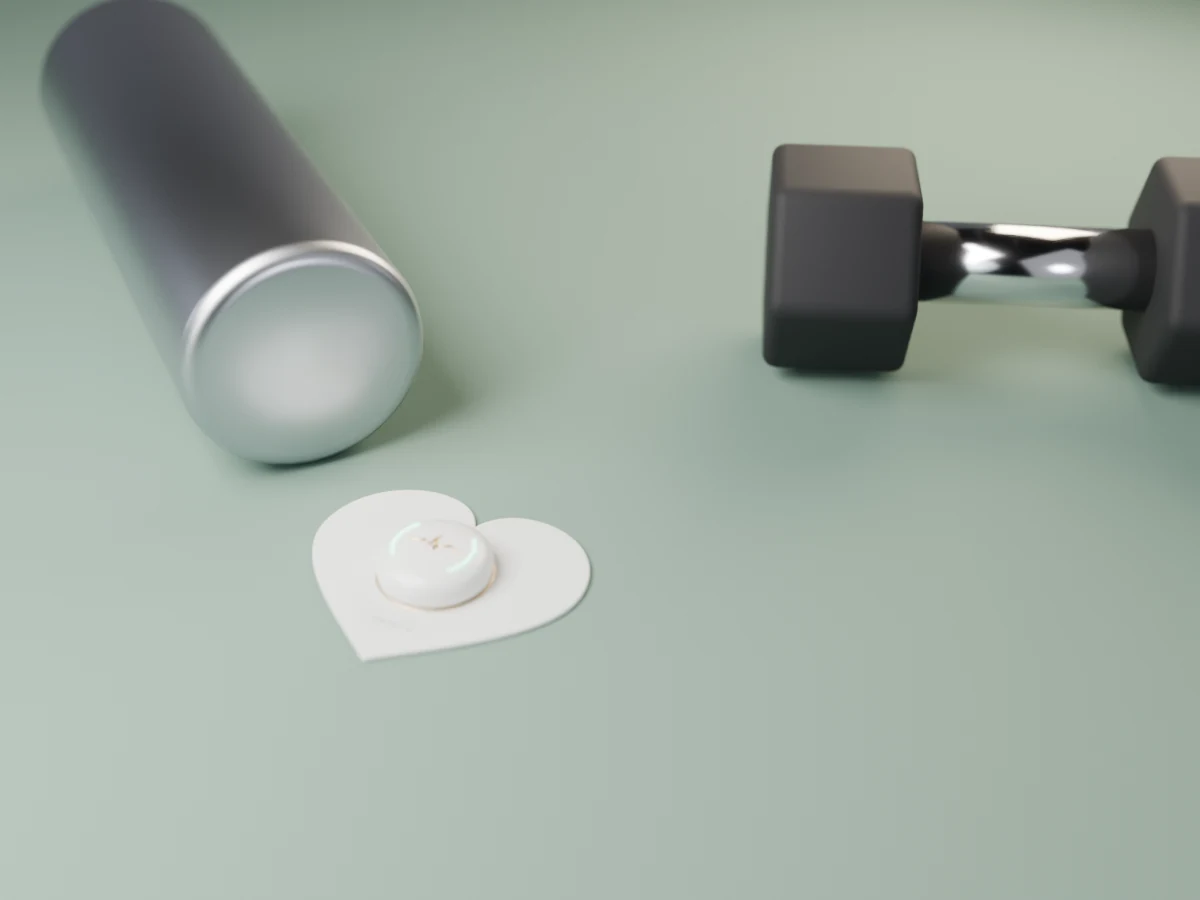
Heart rate and rhythm during walks and exercise, with motion data to explain any noise.
Comfortable, wire-free wear through the night, with posture and SpO₂.
Raw signals and spreadsheets for study teams, with signal quality marked on every sample.
Scenes are photoreal renders of the Hridya enclosure concept. Hridya is a research device and is not yet certified for clinical use.
Vitals in motion
Pick an activity to see how heart rate, SpO₂ and movement change, and how the signal quality is tracked while the wearer moves.
Sitting still. A clean single-lead ECG and a steady optical pulse.
Why readings change on the move: SpO₂ and motion artifacts. Illustrative demo signals generated in your browser, not recordings. Values are typical for a healthy adult. Each small square is 40 ms by 0.1 mV.
The companion app
Live signals, recordings and reports on Android. Screens shown with demo readings.
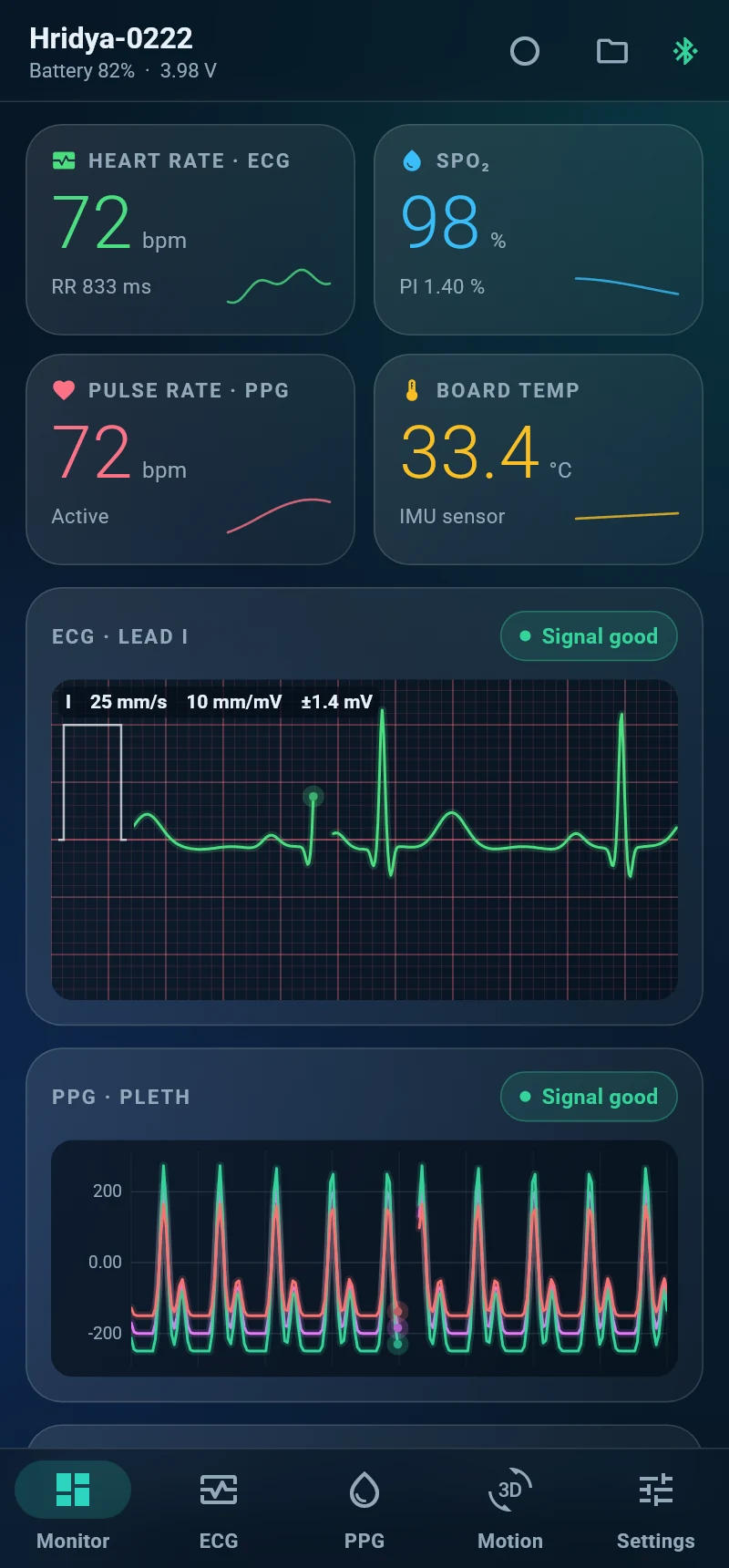
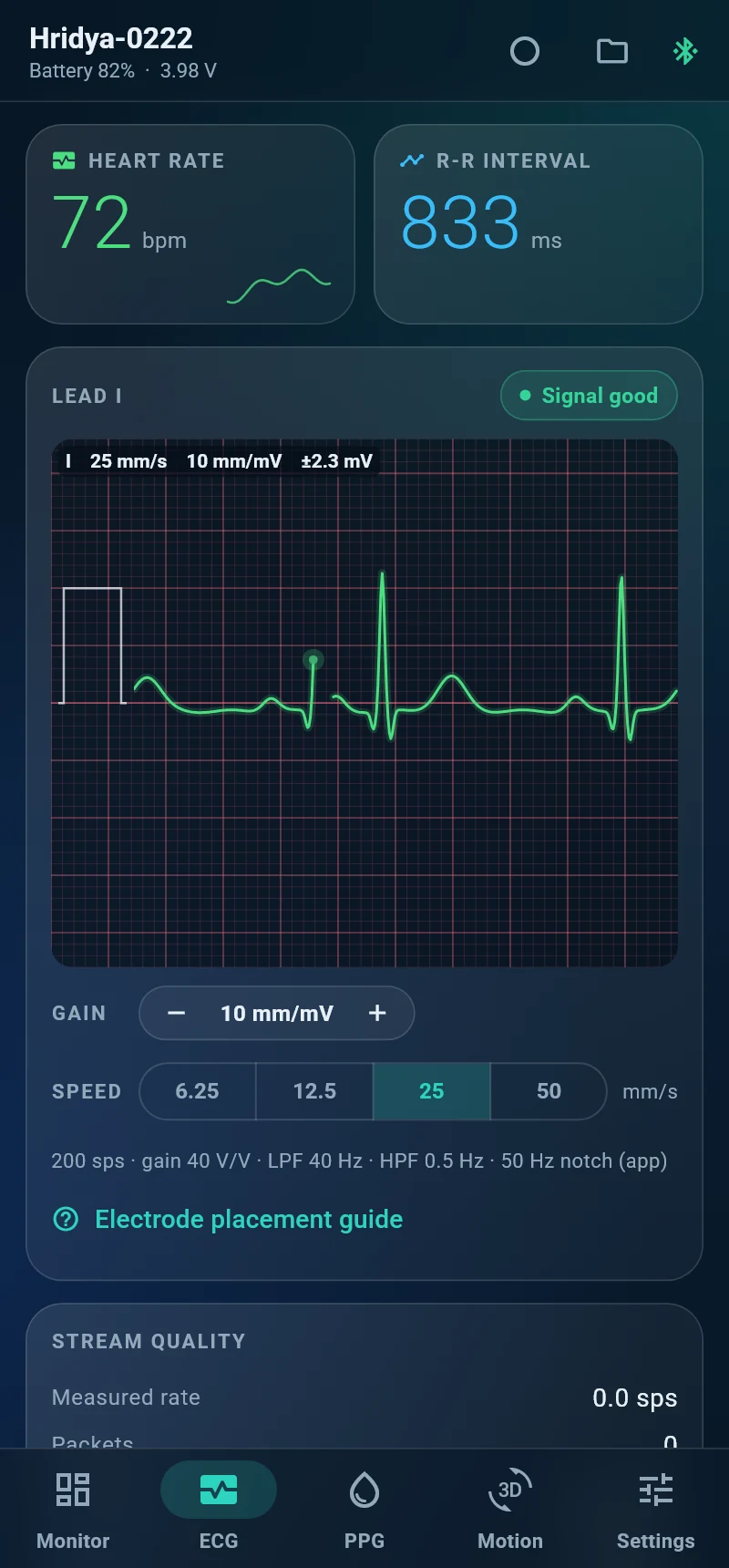
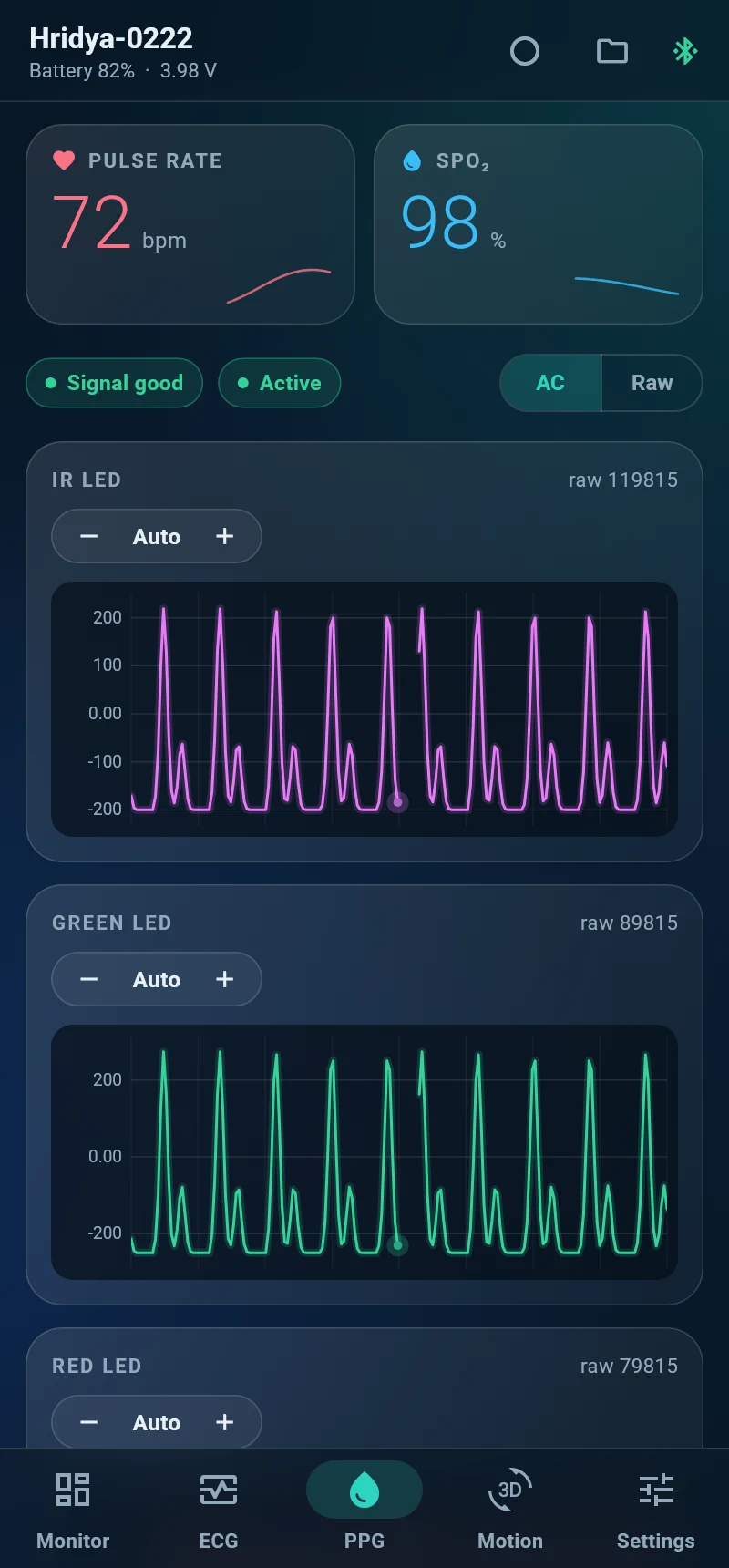
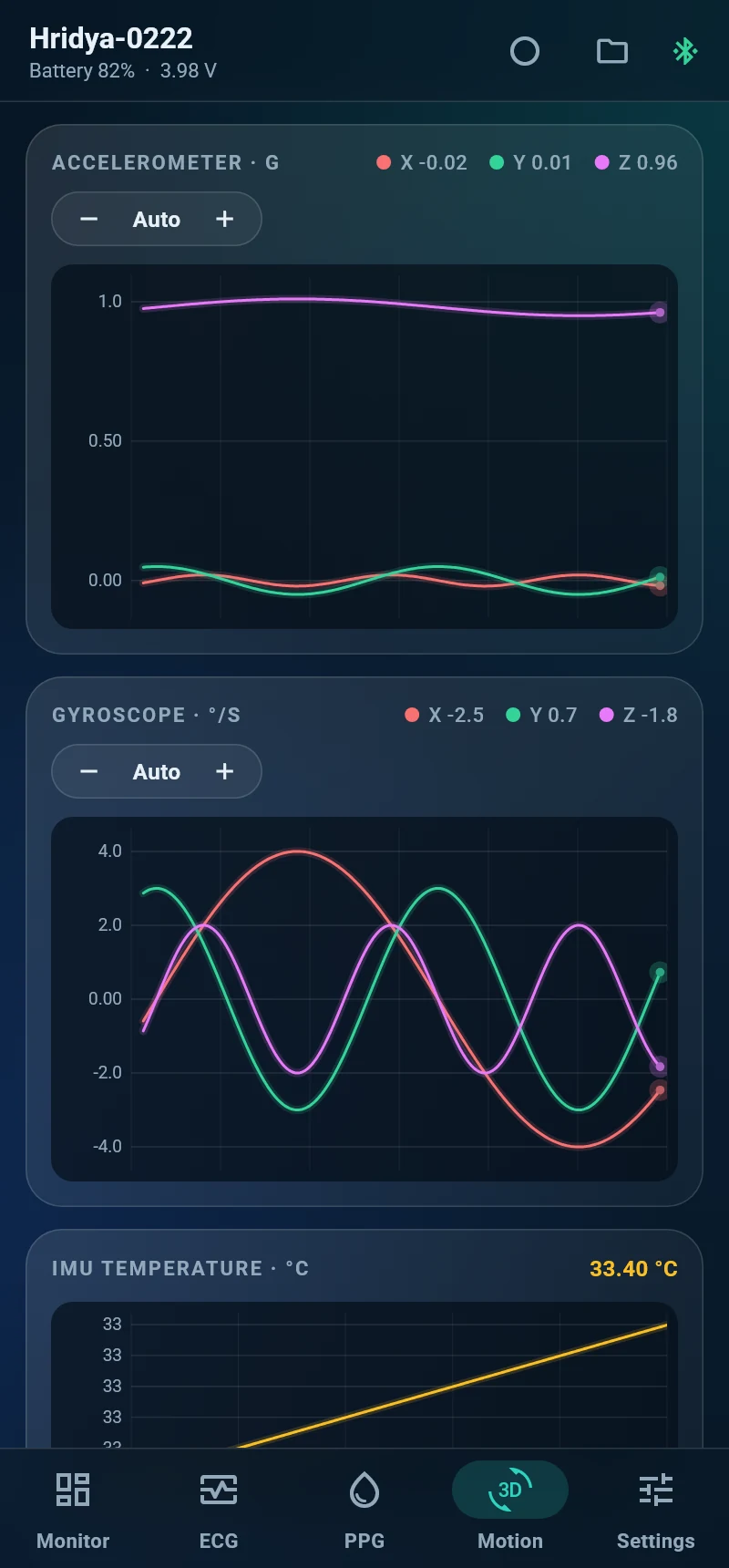
25 mm/s and 10 mm/mV with a 1 mV calibration pulse, the conventions doctors read every day.
Each trace is marked good, fair or poor, with the reason: leads off, movement, noise or no skin contact.
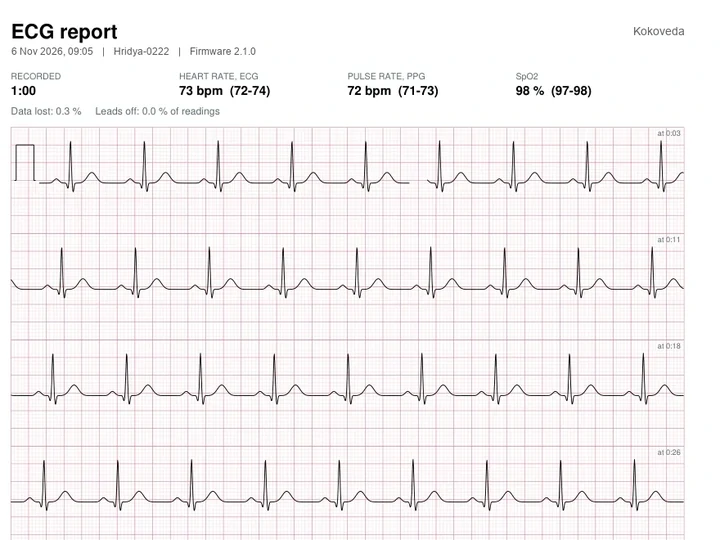
Sessions save to the phone as spreadsheets. Any stretch becomes a one-page A4 ECG report.
Step-by-step placement with a live check that says when the signal is ready to record.
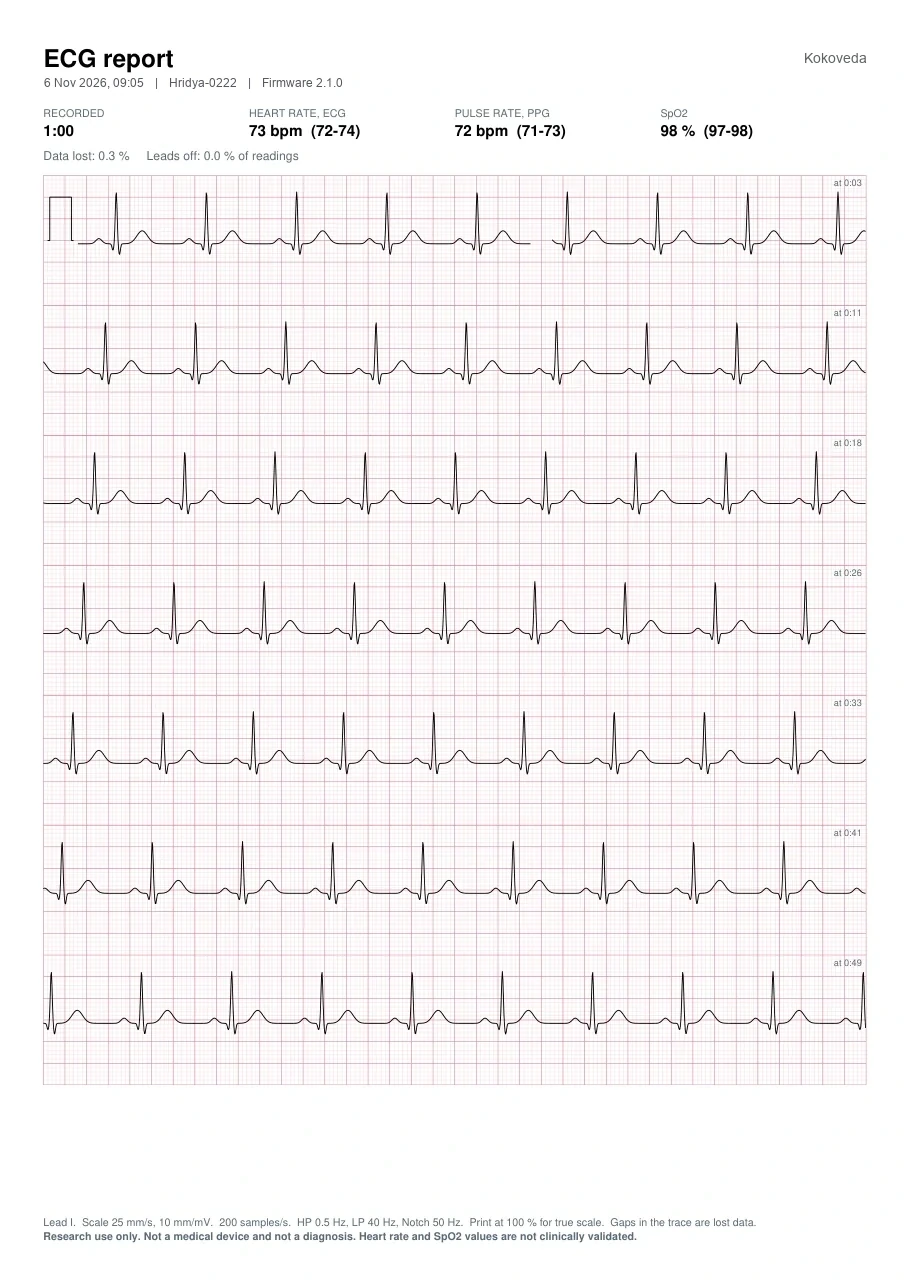
Seven rows of Lead I on a 1 mm grid, with heart rate, pulse and SpO₂ ranges and the lost-data figure. Gaps stay visible instead of being joined up.
Generated from demo data. Hridya is a research device and not certified for diagnosis.
Custom development
Have your own prototype, or need a different device? The team that built Hridya also builds custom wearables. Most projects stall where the hardware, firmware and app teams meet. We cover all three, so the signal stays right from the skin to the screen.
Sensor and chip selection, schematics, PCB layout, power budget and battery design for small body-worn devices. ECG patch development
Sensor drivers, filtering, low-power modes and a robust Bluetooth link that keeps every sample. Firmware and Bluetooth LE
Apps with live medical-style charts, pairing that just works, recordings and settings. Apps for medical wearables
Heart rate, SpO₂, mains-noise filters and signal-quality checks, tested against recorded data. SpO₂ and PPG wearables
Spreadsheet export, PDF reports and data formats ready for your research team or your cloud.
First boards brought to life, test tools for your bench, and data from real people wearing the device.
Medical wearables are our focus. The same sensing, low-power firmware, Bluetooth and app work carries over to industrial and automotive devices.
ECG, SpO₂ and motion wearables, remote patient monitoring devices and research tools. Develop Hridya or build your own device.
Wireless sensor nodes, vibration and condition monitoring, long battery life and apps for your data. Industrial devices.
In-cabin and driver sensing, Bluetooth accessories and data loggers, from prototype to pre-production. Automotive projects.
Working products are the best proof of what a team can do. These two run on real hardware today.
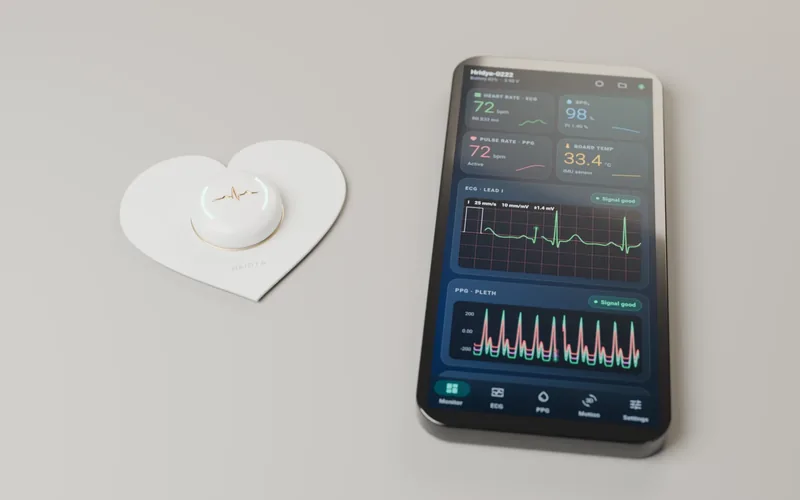 Medical · prototype
Single-lead ECG, optical pulse, SpO₂ and motion, streamed to an Android app with A4 ECG reports. Ready to develop into your product.
 Studio lighting · working
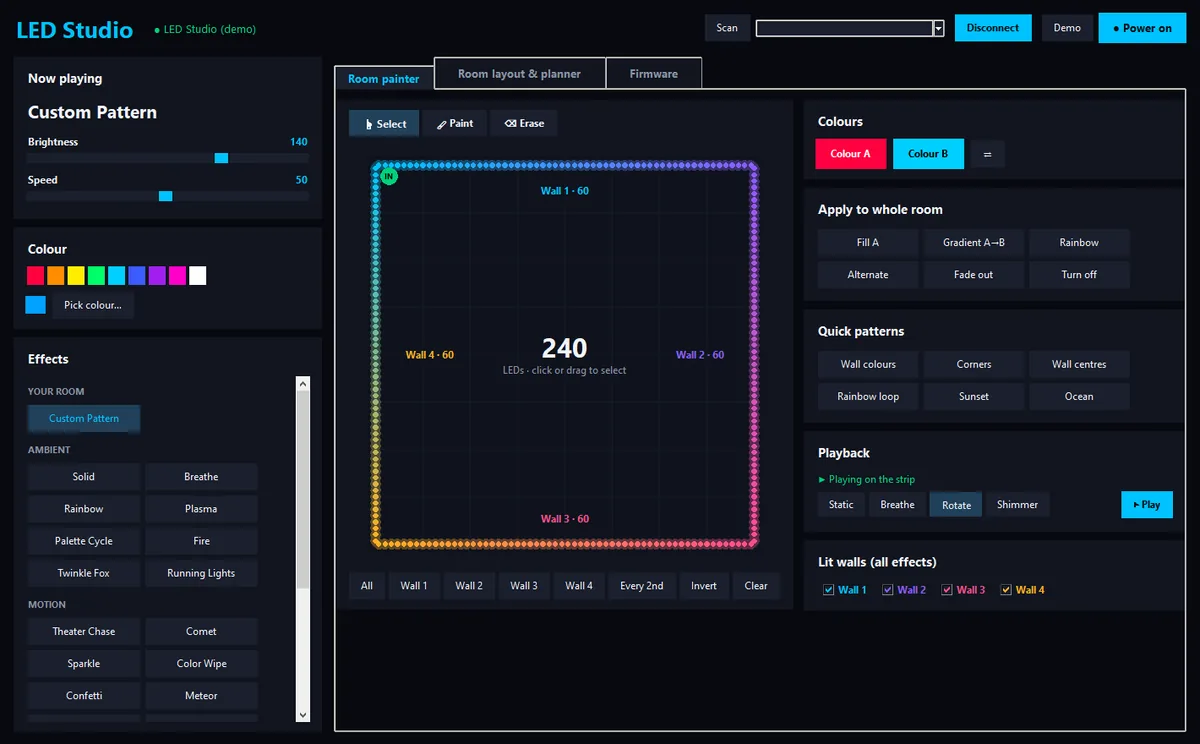
Bluetooth room lighting for studios: up to 1000 LEDs, a room painter, 23 effects, music-reactive mode, and Android and desktop apps.
How we work
Each step ends with something you can hold or test, and a clear decision about the next one.
We agree what the device must measure, who wears it, for how long, and what counts as a good enough signal.
We pick the sensors, design the board and bring the first units to life on the bench.
Firmware and app grow together, so every setting and reading is checked end to end on real hardware.
Devices go on real people. You receive schematics, source code, test data and the notes your team needs.
Sensor choice, first signals on a development board and a written plan with costs, risks and a timeline. The cheapest way to find out if your idea works.
A fixed-scope build from first prototype to pilot units, paid by milestone. Each milestone ends with hardware you can test.
Start from the working Hridya firmware, signal processing, app and report engine, and develop it with us under your own brand. How it works.
Small device batches for studies, plus firmware and app updates and support once devices are in the field.
Timelines depend on the device and are agreed in writing before work starts.
Certification is a long road. Designing with it in mind from the first board saves a redesign later. These are the standards we follow when we design and document a device. Read the full standards map.
Kokoveda is not a certification body, and Hridya is not certified. For approvals such as CDSCO in India, CE marking in Europe or FDA clearance in the US, we work alongside your regulatory partner and hand over design records ready for their review.
Insights
What we learn building Hridya: signals, power, apps and the road to certification.
How electrode spacing, skin contact and the front end decide whether a patch records a usable ECG.
Motion artifacts, the accelerometer as a witness, and honest signal-quality flags.
The cost drivers, phase by phase, from feasibility to certification.
Why longer, more comfortable wear finds more arrhythmias, and what that means for patch design.
All engineering notes, including the standards map, battery life and studio LED lighting.
FAQ
Short answers to what product teams want to know before a first call. More on the Develop Hridya page.
Yes. We develop it with you into a medical wearable under your brand, starting from its working firmware, signal processing, Bluetooth protocol, app and report engine. Commercial terms are agreed in writing for each partner.
The electronics, firmware and Android app work on the bench. Still to come are the wearable enclosure, longer battery life, bench testing against a reference recorder, a pilot study and certification with your regulatory partner. Hridya is a research device and is not certified today.
Yes. We are happy to sign a mutual NDA before you share details of your product, market or clinical plans.
We engineer medical wearables: the sensor electronics, low-power firmware, Bluetooth link and mobile app for devices that measure ECG, SpO₂, pulse and motion. We take a device from first prototype to a pilot with real users.
Yes. If you already have a prototype, we can improve its signal quality, rewrite or extend its firmware, or build the mobile app and reports around it.
We build research and pilot devices. For certification we work alongside your regulatory partner and keep our design records, test data and documentation ready for them.
You do. At handover you receive the schematics, source code, test data and the notes your team needs to continue.
Hridya is our reference design and a research device, not a certified medical product. Companies can develop it with us into their own product, starting from its working firmware, Bluetooth link, app and report engine.
Our reference patch records single-lead ECG at 200 samples per second, optical pulse and SpO₂ with green, red and infrared light, and motion from a 6-axis accelerometer and gyroscope.
A feasibility sprint usually takes 2 to 4 weeks. A full design project from first prototype to pilot units usually takes 3 to 6 months, depending on the device. Starting from the Hridya core shortens both.
We design and document toward IEC 60601-1 for electrical safety, IEC 60601-1-2 for EMC, IEC 62304 for software, ISO 14971 for risk management, ISO 13485 for quality records, ISO 10993 for skin-contact materials and IEC 62366-1 for usability. Certification itself is done with your regulatory partner.
About
心 Kokoro is the Japanese word for heart, mind and spirit. Veda is India’s oldest word for knowledge. Kokoveda brings them together: knowledge of the heart.
That is the work. We build the devices that doctors and health teams rely on, and we measure it by one thing: whether the signal on the screen can be trusted.
Start a project
A few lines are enough: your market, who will wear the device and your timeline. We reply with questions and a first plan, and sign a mutual NDA before details are shared.