
ECG Patch Development Services
We design wearable ECG patches end to end: the electrodes and analog front end, the firmware that keeps every sample, and the app and reports clinicians read.
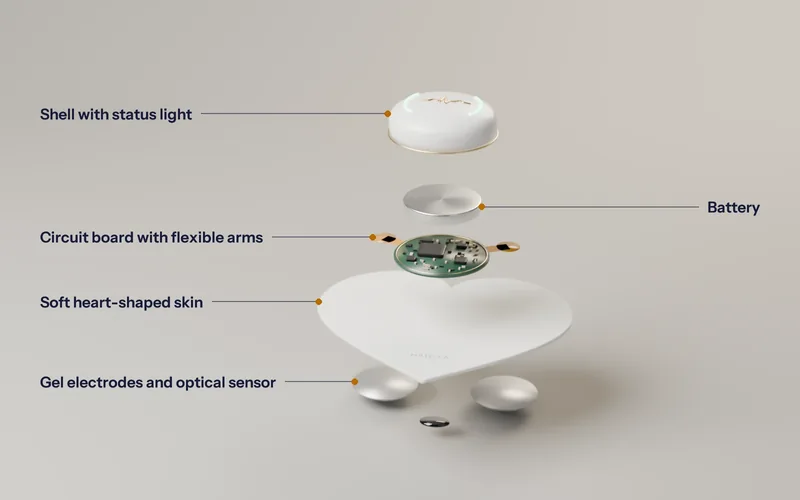
What we deliver
- Electrode and placement design. Electrode spacing, size and material for the signal you need, and a placement guide for wearers.
- ECG analog front end. Selection and layout of a low-noise ECG front end with lead-off detection and mains-noise rejection.
- Firmware. Sampling, filtering, lead-off and signal-quality checks, low-power modes and reliable Bluetooth LE streaming.
- App and reports. Live ECG on calibrated paper at 25 mm/s and 10 mm/mV, recordings and one-page A4 ECG reports.
- Bench testing. Tests against a reference ECG recorder and simulator, with the data handed to you.
Proof, not slides
Our own reference patch, Hridya, records single-lead ECG at 200 samples per second alongside optical pulse, SpO₂ and motion, and streams it to our Android app. Your project can start from that working core instead of a blank page.
How a project runs
- Feasibility sprint, typically 2 to 4 weeks: requirements, sensor choice, first signals and a written plan with costs and risks.
- Prototype: board, firmware and app built together and tested end to end on real hardware.
- Pilot and handover: devices on real people, then schematics, source code, test data and notes handed to your team. You own the result.
We design toward IEC 60601-1, IEC 62304 and ISO 14971 from the first board. Hridya is a research device and not certified; certification is done with your regulatory partner.
Questions
How long does it take to develop an ECG patch prototype?
A feasibility sprint with first signals usually takes 2 to 4 weeks. A working wearable prototype with firmware and app usually takes 3 to 6 months, depending on the requirements. Starting from the Hridya core shortens both.
Single-lead or multi-lead?
Single-lead patches suit rhythm monitoring and are small and comfortable. Multi-lead designs give more diagnostic information but need more electrodes or a larger device. We help you choose based on what the device must detect.
Can you improve the signal quality of our existing ECG device?
Yes. We review electrode design, front-end layout, filtering and firmware, measure the noise sources and fix them step by step.
Further reading
- Designing a single-lead ECG patch: electrodes, spacing and signal quality
- ECG patch vs Holter monitor: what the evidence says
Other services
- SpO₂ and PPG Wearable Design
- Wearable Firmware and Bluetooth LE Development
- Mobile App Development for Medical Wearables
- Develop an ECG Patch Under Your Own Brand
- Remote Patient Monitoring Device Development
- Wearable ECG Patch Development in India
Want an ECG and SpO₂ patch under your own brand?
Our prototype, Hridya, already records ECG, SpO₂ and motion and streams them to its own app. Develop it with us into your product, or let the same team build your own device.