
SpO₂ and PPG Wearable Design
Optical sensors are easy to get working on a still finger and hard to get right on a moving body. We design the optics, firmware and checks that make pulse and SpO₂ readings trustworthy.
What we deliver
- Optical sensor selection. Integrated optical modules or discrete LEDs and photodiodes, chosen for the body site, skin tones and power budget.
- Optical and mechanical layout. Window, light barriers and skin contact designed to keep ambient light out and the signal stable.
- Pulse and SpO₂ algorithms. Heart rate and SpO₂ from green, red and infrared light, with calibration planning for accuracy studies.
- Motion handling. Accelerometer data used to detect, flag and reduce motion artifacts during walking, exercise and sleep.
- Signal quality. Every reading marked good, fair or poor with a reason, so nobody mistakes noise for a real change.
Proof, not slides
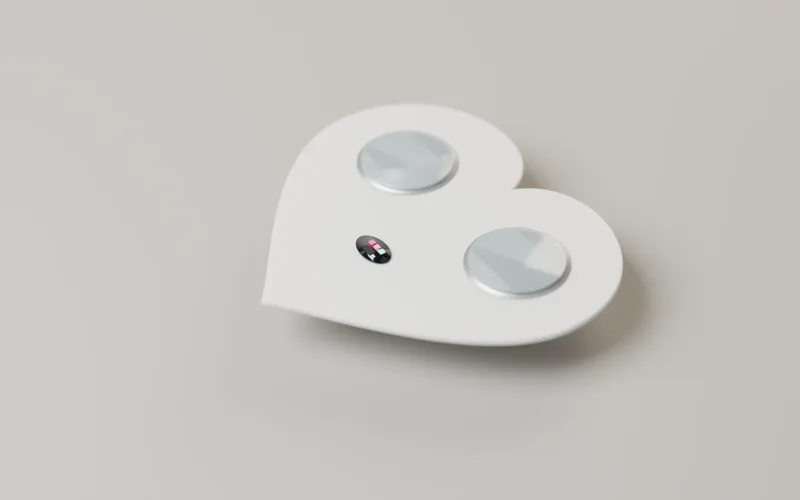
Hridya combines an optical pulse and SpO₂ sensor with single-lead ECG and a 6-axis motion sensor. The ECG gives an independent heart rate to cross-check the optical reading, and the motion data explains noise.
How a project runs
- Feasibility sprint, typically 2 to 4 weeks: requirements, sensor choice, first signals and a written plan with costs and risks.
- Prototype: board, firmware and app built together and tested end to end on real hardware.
- Pilot and handover: devices on real people, then schematics, source code, test data and notes handed to your team. You own the result.
We design toward IEC 60601-1, IEC 62304 and ISO 14971 from the first board. Hridya is a research device and not certified; certification is done with your regulatory partner.
Questions
Why do SpO₂ readings go wrong during movement?
The pulse part of the optical signal is small, and movement of the sensor on the skin can be larger. We use an accelerometer to detect motion and mark readings that should not be trusted. See our article on SpO₂ and motion artifacts.
Can SpO₂ be measured on the chest?
Yes, with reflective sensors designed for it, though the signal is usually weaker than on a finger. Sensor choice, LED power and placement matter a lot, and accuracy has to be checked in a study.
Do you handle SpO₂ accuracy testing?
We prepare the device, firmware and test plan. Formal accuracy studies for certification are run with a clinical partner under the relevant standard, such as ISO 80601-2-61.
Further reading
- Why SpO₂ and heart rate fail on the move, and how a wearable can tell
- Designing a single-lead ECG patch: electrodes, spacing and signal quality
Other services
- ECG Patch Development Services
- Wearable Firmware and Bluetooth LE Development
- Mobile App Development for Medical Wearables
- Develop an ECG Patch Under Your Own Brand
- Remote Patient Monitoring Device Development
- Wearable ECG Patch Development in India
Want an ECG and SpO₂ patch under your own brand?
Our prototype, Hridya, already records ECG, SpO₂ and motion and streams them to its own app. Develop it with us into your product, or let the same team build your own device.