
Home / Develop Hridya
A working ECG and SpO₂ patch, ready to become your product
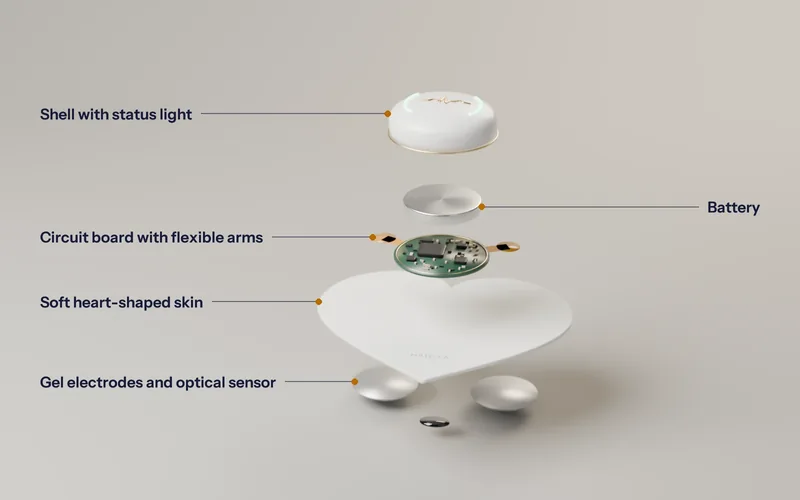
Hridya is our wearable patch prototype: single-lead ECG, optical pulse, SpO₂ and motion, with its own firmware and Android app. We are looking for companies that want to develop it with us into a medical wearable under their brand.
Who this is for
- Remote patient monitoring companies that want their own ECG and SpO₂ patch instead of reselling someone else’s.
- Medical device makers adding a wearable cardiac product to their range.
- Hospitals and cardiac care providers that want a monitor built around their own care pathway.
- Research groups that need a study device with raw signals and open data formats.
What already works
- Prototype hardware, version 0.2, running on the bench
- Single-lead ECG at 200 samples per second
- Optical pulse and SpO₂ with green, red and infrared light
- 6-axis motion: accelerometer and gyroscope
- Firmware streaming all signals over Bluetooth LE
- Android app: live charts, signal quality, recordings and A4 ECG reports
You start from working hardware, firmware and an app, not from a blank page. Getting a clean signal from the skin to the phone is usually the slowest part of a new wearable, and Hridya is past that step.
Technical summary
| Item | Today |
|---|---|
| ECG | Single lead, 200 samples per second, lead-off and signal-quality checks |
| Pulse and SpO₂ | Optical sensor with green, red and infrared light |
| Motion | Accelerometer and gyroscope, used to flag motion artifacts |
| Radio | Bluetooth Low Energy streaming with live settings from the app |
| App | Android: live charts on calibrated paper, recordings, spreadsheet export, A4 PDF ECG reports. iPhone planned. |
| Hardware status | V0.2 board working on the bench. Enclosure is a concept, first wearable prototype in progress. |
| Certification | Not certified. Designed toward IEC 60601-1, IEC 62304 and ISO 14971. |
From prototype to your product
- Product brief. Typically 2–4 weeks. Your users, target markets, brand and the sensors you need, turned into a written plan with costs, risks and a timeline.
- Wearable prototype. The heart-shaped enclosure, electrodes and skin adhesive, longer battery life, your branding and an iPhone app if you need one.
- Verification and pilot. Bench tests against a reference ECG recorder, then small batches for a study with your hospital or research partner.
- Certification and manufacturing. Design records toward IEC 60601-1, IEC 62304 and ISO 14971, prepared for your regulatory partner and contract manufacturer.
Each phase ends with something you can test and a clear decision about the next one. Timelines and costs are agreed in writing before work starts. See what drives the cost of a medical wearable.
What you get as a development partner
- A head start. Months of sensor, firmware and app work already done and tested.
- Your brand. Enclosure, app and reports carry your name and design.
- One team, end to end. The engineers who built the hardware, firmware and app develop your version.
- Honest status. We tell you what works, what is a concept and what is still a risk, as on our status board.
- Confidentiality. A mutual NDA before you share your plans.
Questions
Can we develop Hridya as our own branded product?
Yes. That is what Hridya is for. We develop it with you into a device under your brand, starting from its working firmware, signal processing, Bluetooth protocol, app and report engine. Commercial terms are agreed in writing for each partner.
What is left before Hridya can be sold?
The electronics, firmware and Android app work on the bench. Still to come: the wearable enclosure, longer battery life, bench testing against a reference recorder, a pilot study and certification such as CDSCO, CE or FDA with your regulatory partner. Hridya is a research device and is not certified today.
How long does it take to reach pilot-ready devices?
It depends on your requirements and markets. The first step is a product brief of typically 2 to 4 weeks, which ends with a written plan, timeline and cost. Starting from a working prototype removes the slowest early steps of a new wearable.
Can you change the sensors or the shape?
Yes. The core can drop or add sensors, change the body site or move to a different enclosure. We tell you during the product brief which changes are cheap and which reset parts of the work.
Do you sign an NDA?
Yes. We are happy to sign a mutual NDA before you share details of your product, market or clinical plans.
Who owns what at the end?
Work we do specifically for you, such as your enclosure, branding and custom features, is handed over to you with source files. How the Hridya core is used in your product is set out in the partner agreement. Both are agreed in writing before work starts.
Need a different device?
If you have your own prototype or need a different wearable, we build that too:
- ECG Patch Development Services
- SpO₂ and PPG Wearable Design
- Wearable Firmware and Bluetooth LE Development
- Mobile App Development for Medical Wearables
- Develop an ECG Patch Under Your Own Brand
- Remote Patient Monitoring Device Development
- Wearable ECG Patch Development in India
Interested in developing Hridya?
Tell us your market, your users and your timeline. We reply with questions and a first plan.
Start the conversation